Schluter®-DITRA-HEAT
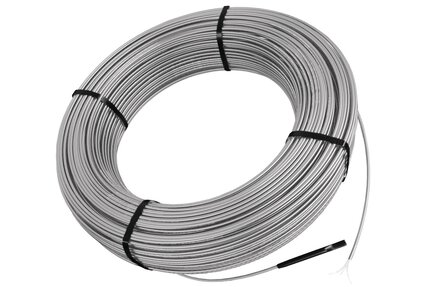
Membrana de desacoplamiento para cables calefactores eléctricos para pisos radiantes DITRA_HEAT-E-HK

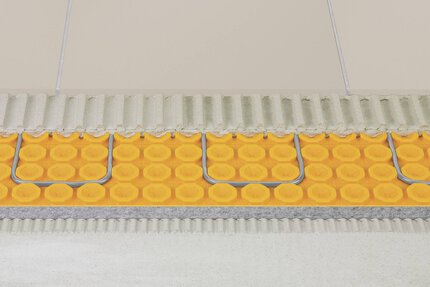
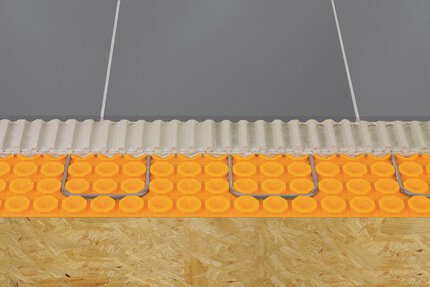
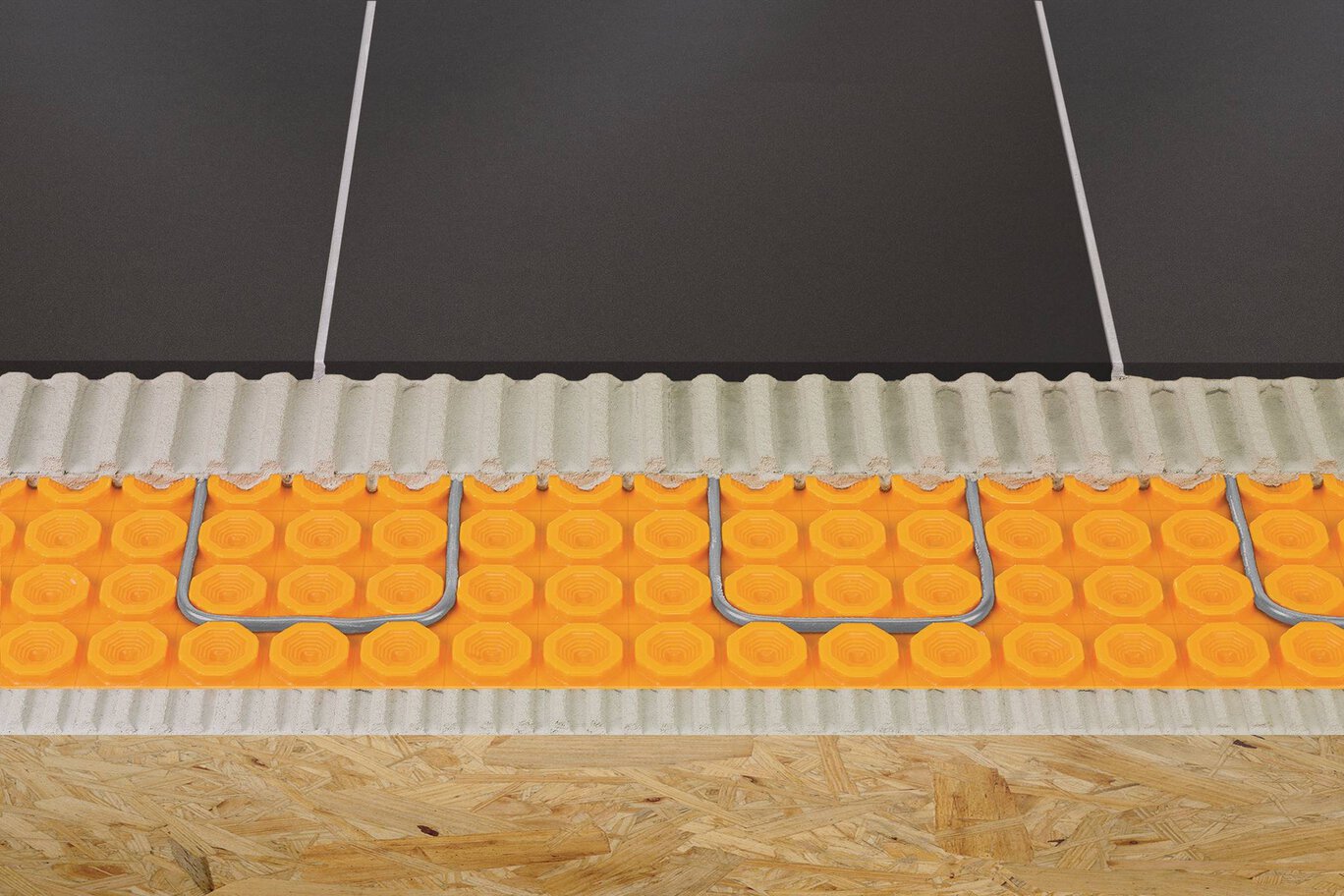
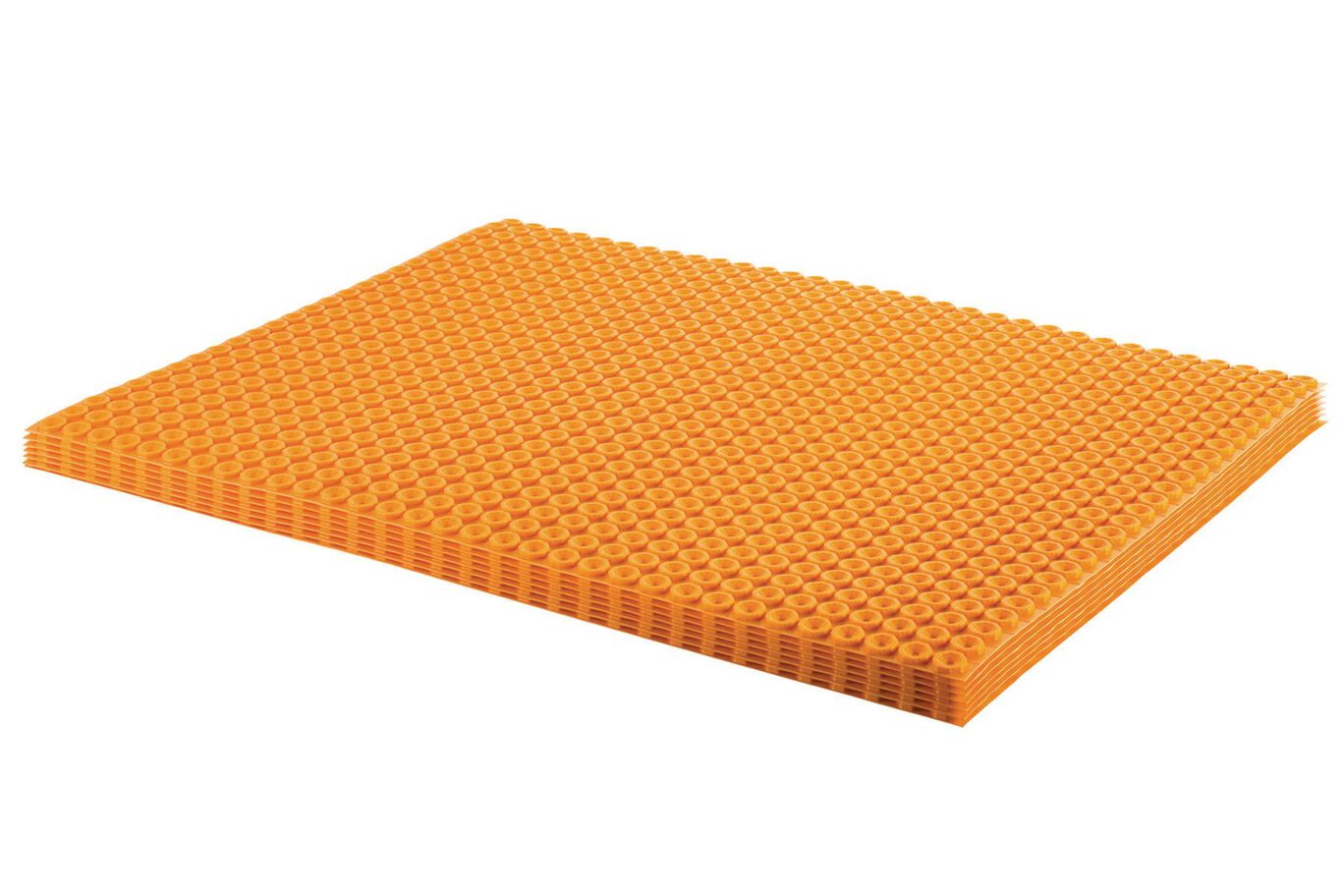
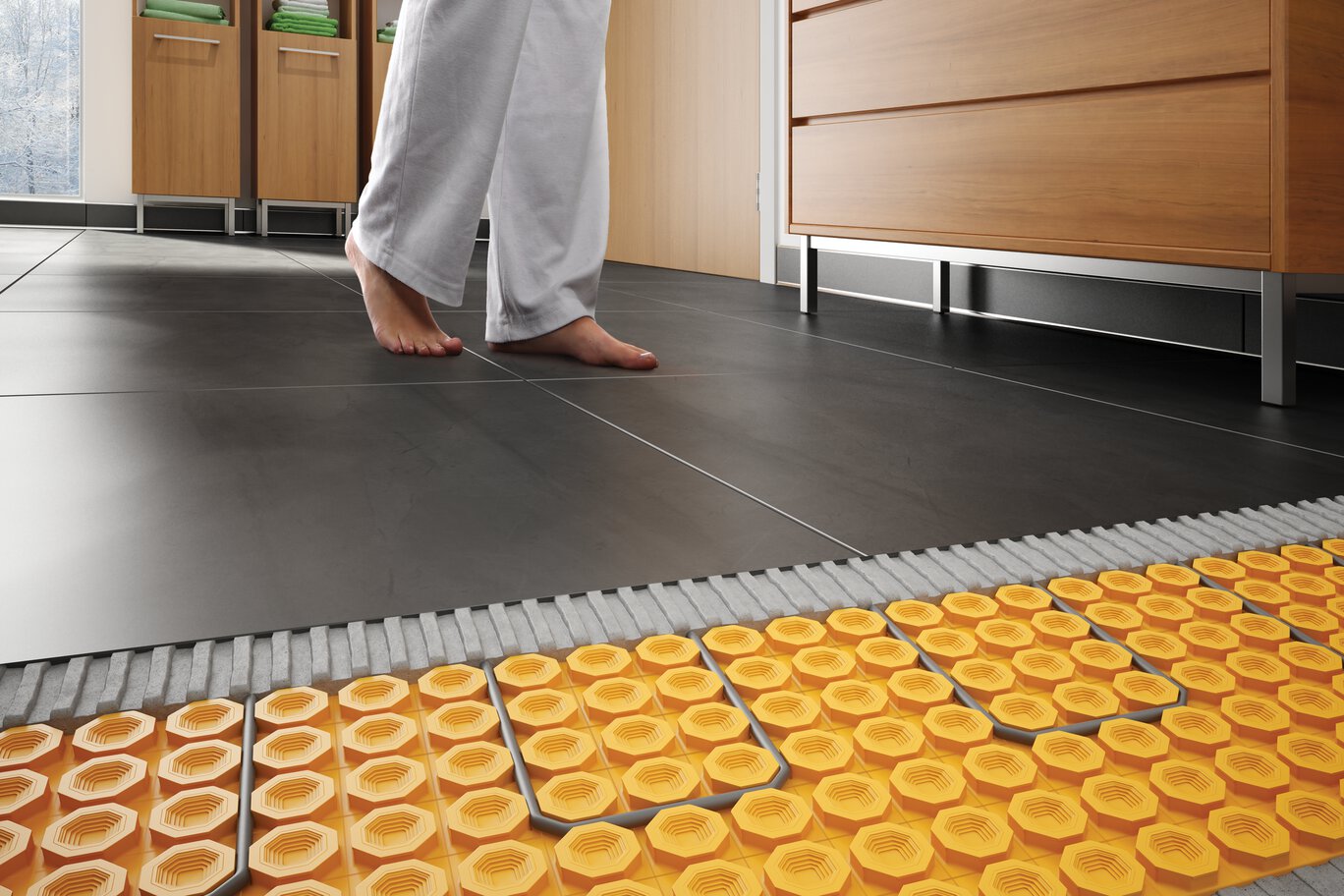
- La estructura nodular de DITRA-HEAT está específicamente concebida para facilitar la instalación de los cables calefactores DITRA-HEAT-E-HK.
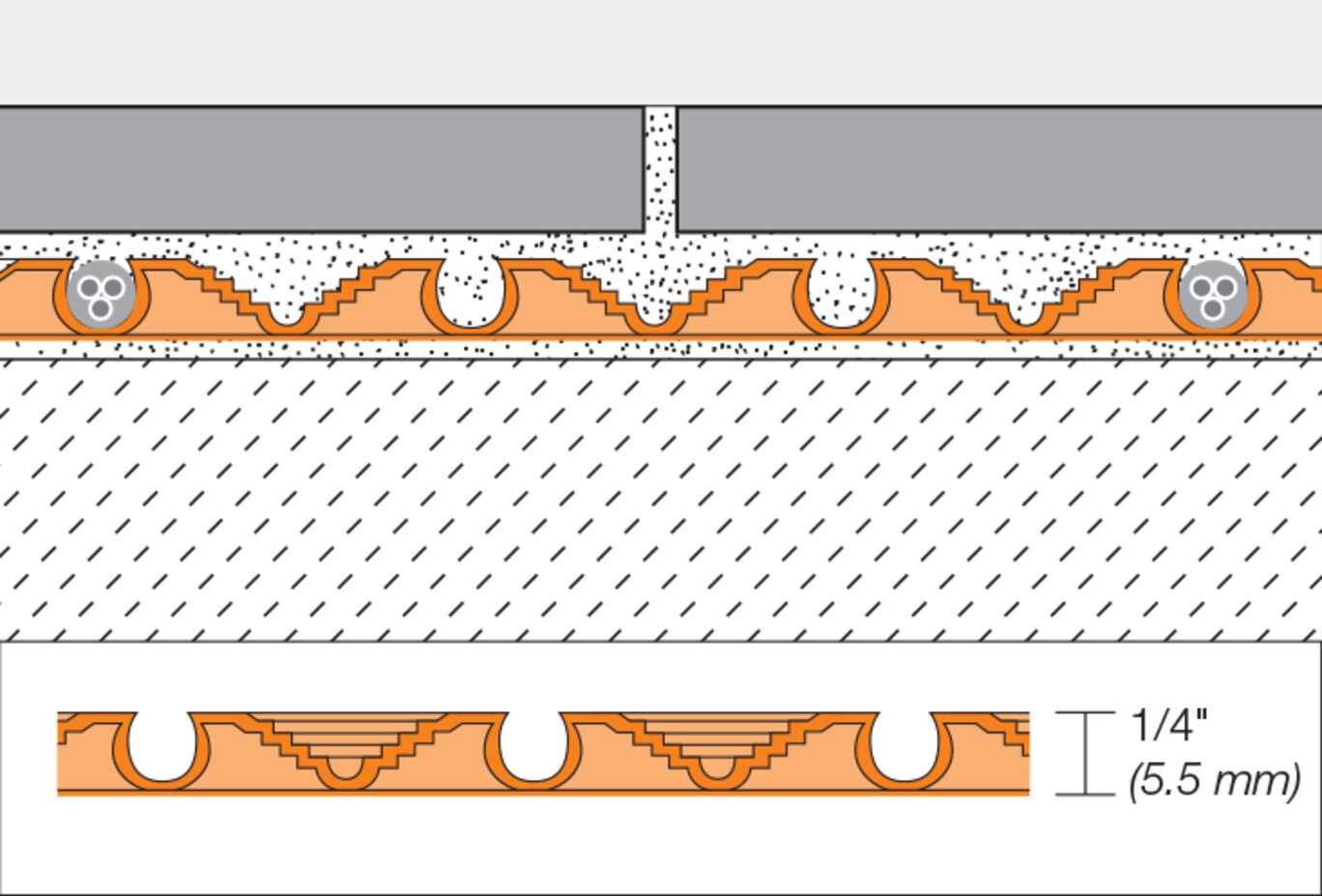
- Un espesor nominal de 1/4" (5,5 mm) minimiza el grosor del ensamblado y reduce la transición a revestimientos de menor altura.
- No se requieren componentes de autonivelación para encapsular los cables en la membrana.
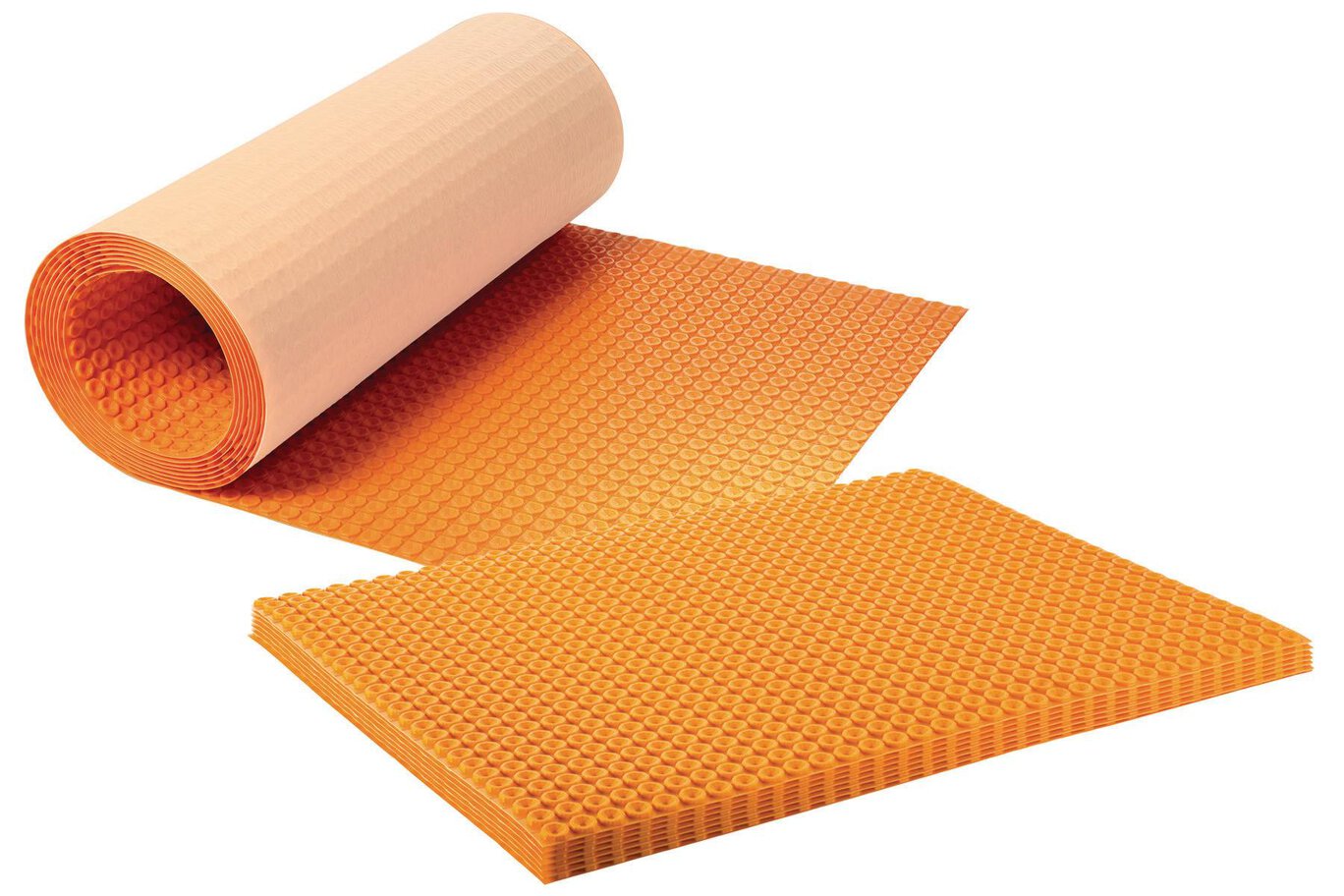
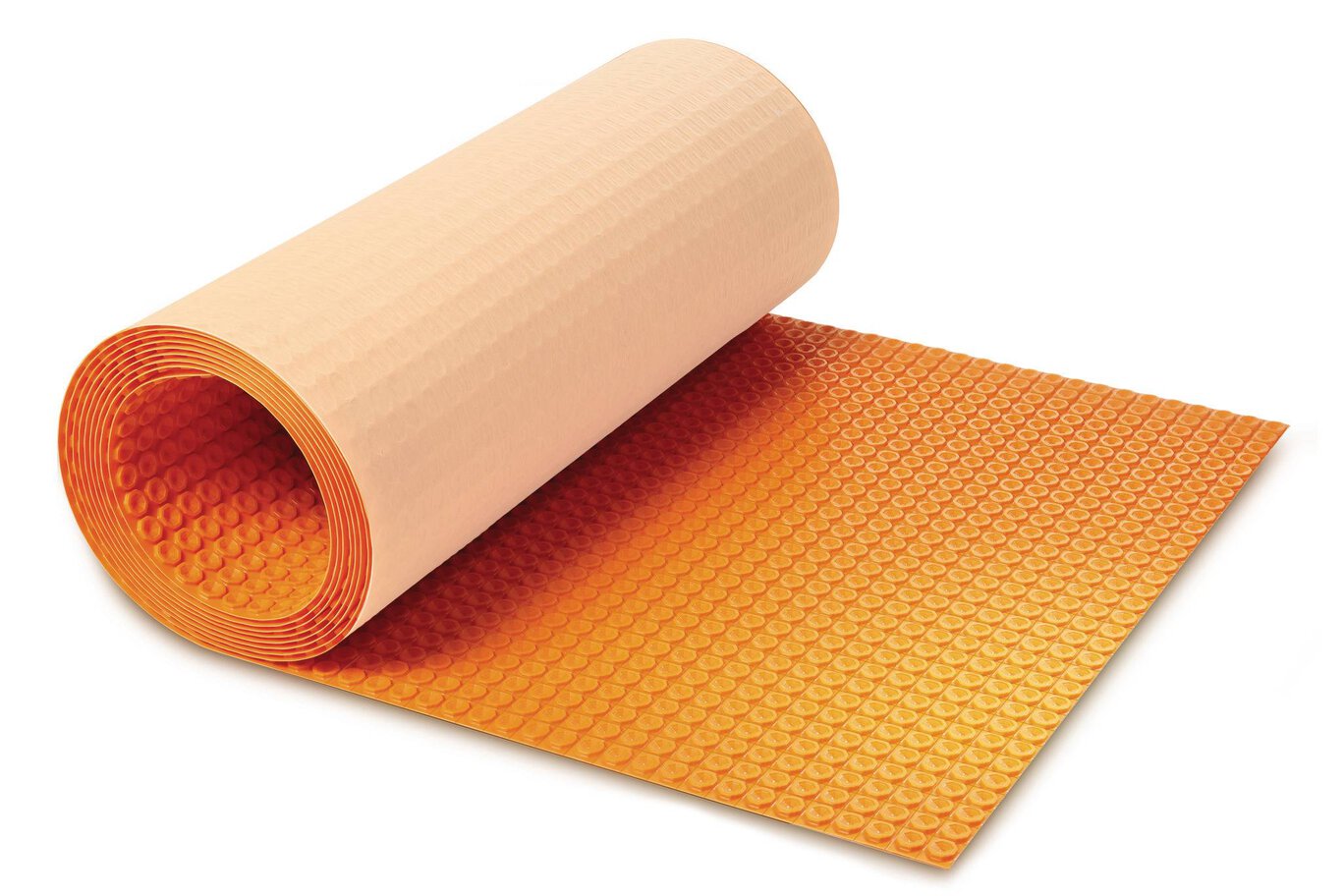
- Disponible en rollos o en láminas para adaptarse a distintos tamaños de habitación.
- Se instala rápida y fácilmente y se necesitan pocas herramientas
- Ofrece calefacción eléctrica del piso para uso debajo de baldosas, piedra u otros revestimientos resistentes (por ej., LVT)
Encuentre aquí los accesorios recomendados

Estimador DITRA-HEAT
Calcule sin esfuerzo sus necesidades de membranas y cables.
Schluter® DITRA-HEAT suma una función personalizable y cómoda de calefacción eléctrica del piso a las funciones de DITRA: desacoplamiento, impermeabilización, control del vapor y soporte para asegurar una instalación duradera.
Calefacción del piso
DITRA-HEAT combina la flexibilidad de los cables calefactores sueltos con la facilidad de instalación de los sistemas de membranas. Los cables pueden ubicarse donde sea que se desea calefaccionar, sin crear diferencias de altura en el piso. No se requiere el uso de componentes autoniveladores para encapsular los cables, lo que reduce el tiempo y el esfuerzo de instalación.
Desacoplamiento
Las baldosas llevan años instalándose de manera exitosa mediante la incorporación una membrana de desacoplamiento, o interfaz resistente al cizallamiento, en el conjunto de baldosas. DITRA-HEAT brinda desacoplamiento por medio de su configuración geométrica, la que permite un movimiento de los planos que neutraliza de manera efectiva el movimiento de tensión diferencial entre el substrato y las baldosas, eliminando así la causa principal de rotura y astillamiento de la superficie revestida.
Impermeabilización
DITRA-HEAT ofrece una impermeabilización confiable. El material de polipropileno del que se compone protege el substrato de la penetración de humedad, lo que es particularmente importante en los edificios actuales en donde la mayoría de los substratos son sensibles a la humedad.
Control del vapor
El espacio libre en la parte inferior de DITRA-HEAT ofrece un escape para el exceso de humedad y vapor del substrato, el cual de otro modo podría causar deterioros al revestimiento de baldosas situado por arriba. De esa manera, DITRA-HEAT controla de manera efectiva la humedad por debajo del revestimiento de baldosas.
Soporte/distribución de la carga
Cuando se colocan sobre una base sólida, las columnas o pilares pueden soportar cargas enormes. El mismo principio físico se aplica a las instalaciones DITRA-HEAT. En la superficie de la membrana se forman entre los nódulos y en los nódulos mismos, estructuras de mortero similares a columnas. Las cargas se transfieren desde el revestimiento del piso a través de estas estructuras de mortero en forma de columna al substrato. Dado que DITRA-HEAT es prácticamente incompresible dentro del conjunto de baldosas, las ventajas del desacoplamiento se consiguen sin sacrificar la capacidad de distribución de cargas puntuales.
Revestimientos de piso alternativos sobre DITRA-HEAT
DITRA-HEAT es adecuado para aplicaciones con madera de ingeniería, vinilo, compuestos de madera y plástico (WPC), baldosas de vinilo de lujo (LVT), planchas de vinilo de lujo (LVP), baldosas y planchas de compuesto de piedra y plástico (SPC) y pisos laminados. Ver el Boletín técnico revestimientos de piso alternativos sobre DITRA-HEAT para más información, requisitos y limitaciones.
Las membranas DITRA-HEAT y DITRA-HEAT-DUO no requieren ningún mantenimiento especial.
Todos los substratos deben estar limpios, parejos y ser capaces de soportar cargas. Deben eliminarse las superficies que impidan la adherencia antes de aplicar DITRA-HEAT. Para la guía completa de instalación y los criterios de garantía, puede descargar y consultar el Manual de instalación de Schluter® DITRA-HEAT o ver en línea el video de instalación.
Nota: el tipo, espesor y formato de las baldosas o piedras del revestimiento deben ser adecuadas para la instalación deseada. El formato mínimo de las baldosas es de 2" x 2" (5 cm x 5 cm).
Las aplicaciones con formatos de baldosas inferiores a 2" x 2" (5 cm x 5 cm) requieren consideraciones especiales. Póngase en contacto con los representantes del servicio técnico de Schluter-Systems en el 800-472-4588 (EE. UU.) o en el 800-667-8746 (Canadá) para obtener más información sobre los requisitos de instalación y la elegibilidad para la garantía.
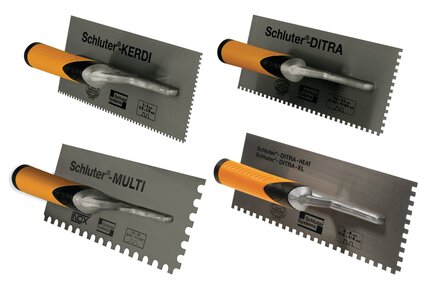
1- Usando un mortero de capa fina adecuado para el substrato, aplíquelo (mezclado a una consistencia suficientemente fluida pero aún capaz de formar una cresta) con una llana dentada cuadrada de 1/4" x 1/4" (6 mm x 6 mm).
2- Aplique DITRA-HEAT al piso, con el geotextil hacia abajo. Empotre sólidamente en el mortero usando una llana, una llana de enrasar o DITRA-ROLLER, asegurándose de respetar el tiempo de apertura del mortero adhesivo. Si el mortero comienza a secarse y hace película antes de instalar la membrana, quítelo y vuelva a aplicar. Nota: puede ser útil enrollar al revés el extremo de la membrana antes de la instalación, o colocar cajas de baldosas encima de la membrana después de la instalación, para evitar que se ondule.
* Cuando use DITRA-ROLLER, ponga un peso (por ej., bolsas de mortero/lechada o una caja de baldosas) no mayor de 75 lbs (34 kg) en el estante del DITRA-ROLLER. Mueva lentamente el rodillo de un extremo a otro de la membrana, solapando ligeramente las pasadas sucesivas.
3- Levante una esquina de la membrana para verificar la cobertura. Si la instalación es correcta, debe haber un contacto completo entre el geotextil y el mortero de capa fina. Nota: la cobertura puede variar dependiendo de la consistencia del mortero, el ángulo al que se sostiene la llana, las condiciones del substrato, etc. Si no se logra una cobertura total, quite y vuelva a aplicar, asegurándose de verificar correctamente la consistencia y aplicación del mortero.
4- Arrime los bordes y laterales de láminas de membrana adyacentes. Nota: alinear los nódulos de la parte superior de la membrana durante la instalación puede facilitar la instalación posterior de los cables calefactores.
5. Ahora puede instalar los cables calefactores DITRA-HEAT-E-HK. Las instrucciones de instalación están en la página de producto de DITRA HEAT-E-HK. Nota: la baldosa puede instalarse directamente sobre la membrana DITRA-HEAT inmediatamente después de que hayan sido instalados los cables Schluter®-DITRA-HEAT-E-HK usando un mortero de capa fina no modificado. Consulte la Guía de instalación de Schluter® DITRA-HEAT a continuación para las instrucciones completas de instalación del sistema DITRA-HEAT.
Revestimientos de pisos alternativos sobre DITRA-HEAT
Para más información consulte DH-AFC > (descargar el Boletín técnico Revestimientos de pisos alternativos sobre DITRA-HEAT) y el Manual de instalación de Schluter® DITRA-HEAT para una guía completa de instalación. Utilice nuestra calculadora DITRA-HEAT para saber qué productos necesita para completar su proyecto.
FAQ
What is the minimum stud spacing when installing the Schluter®-DITRA-HEAT-E-HK heating cables?
A cable spacing of 3 studs between runs is standard. However, cable may also be spaced at continuously alternating 3 stud – 2 stud intervals in isolated...
Leer másCan Schluter®-DITRA-HEAT-E-HK heating cables be installed on a shower bench?
Yes, DITRA-HEAT-E-HK heating cables can be installed on the top surface of shower benches. Care must be taken to install...
Leer másCan mosaic tile be used with Schluter®-DITRA-HEAT?
The minimum required tile format for use with DITRA-HEAT is 2" x 2" (50 mm x 50 mm). Please call Schluter®-Systems...
Leer másCan Schluter®-DITRA-HEAT be installed over vinyl flooring?
Yes, DITRA-HEAT can be installed over vinyl. Some limitations include the following: 1- Cushioned vinyl is unacceptable...
Leer másCan Schluter®-DITRA-HEAT be installed over hardwood flooring?
We don't recommend or warranty DITRA-HEAT installation over existing hardwood flooring as it is very unstable and difficult to bond...
Leer másCan other manufacturer’s heating cables be installed with Schluter®-DITRA-HEAT membrane?
The DITRA-HEAT-E-HK heating cables are specifically designed to integrate with the DITRA-HEAT membrane...
Leer másCan the Schluter®-DITRA-HEAT system be installed in an outdoor installation?
No, the DITRA-HEAT heating cables and membrane cannot be installed outdoors. The heating cables are not rated for exterior applications.
Leer másHow long do I have to wait after the installing Schluter®-DITRA-HEAT to start using the system?
Schluter®-Systems recommends waiting 7 days after grouting before consistent use of the DITRA-HEAT system...
Leer másCan Schluter®-DITRA-HEAT be installed over existing tile?
Installing DITRA-HEAT over existing tile may require special considerations. Please call Schluter®-Systems...
Leer másI plan to install an electric floor warming system on slab on grade. Are there any available Schluter products that can act as a thermal break?
Why is megohmmeter testing strongly recommended for Schluter®-DITRA-HEAT-E-HK heating cables?
The insulation resistance test is intended to detect very small breaks throughout the cable insulation before, during, and after installation...
Leer másWhere can I find a megohmmeter to perform the insulation resistance test?
Megohmmeters may be found at local electrical supply wholesalers or online retailers such as Grainger, Mouser Electronics, Amazon, etc...
Leer másMy megohmmeter is reading OL or I; is this a good reading for the heating cable insulation resistance test?
If your megohmmeter is reading "OL" (over load) or "I" (infinity), these are commonly used readings on megohmmeters...
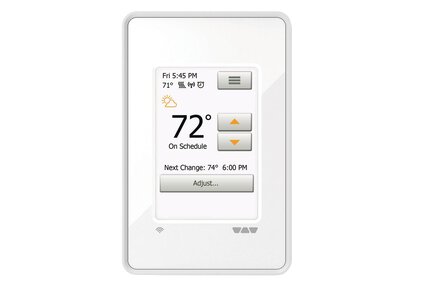
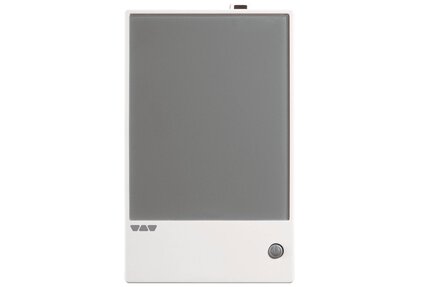
Leer másHow do I connect the Schluter®-DITRA-HEAT-E-HK Heating Cables to a Schluter®-DITRA-HEAT-E-RSD thermostat?
For instructions on connecting the DITRA-HEAT-E-RSD thermostat, please reference the Schluter®-DITRA-HEAT Thermostat User’s Guides or...
Leer másHow do I program the Schluter®-DITRA-HEAT-E-RSD thermostat?
Please see the DITRA-HEAT DHE RS D/BW Thermostat user’s guide for written instructions or see the Tips, Tricks, & FAQ video...
Leer másI ran out of room for my heating cables, can I cut them or put them under my cabinets?
NEVER cut or modify the heating cable in any way. This would change the cable resistance, will cause damage to the cable, and could cause cable overheating...
Leer másHow do I select the correct length Schluter®-DITRA-HEAT-E-HK heating cable for my floor warming project?
The Schluter®-DITRA-HEAT membrane is selected according to the size of the area to be tiled. The DITRA-HEAT-E-HK heating cable is selected...
Leer másWhy are two floor temperature sensors provided with the Schluter®-DITRA-HEAT system?
Both floor temperature sensors are installed within the tile assembly. One sensor is connected to the thermostat, while...
Leer másCan Schluter®-DITRA-HEAT-E-HK heating cables be installed on walls?
What are the restrictions on where I can install the Schluter®-DITRA-HEAT heating cables?
The DITRA-HEAT heating cables cannot be installed under vanities with no air space beneath, bathtub platforms...
Leer másCan more than one DITRA-HEAT-E-HK heating cable be connected to the Schluter®-DITRA-HEAT-E Thermostats ?
Multiple DITRA-HEAT-E-HK heating cables can be connected and controlled by a single DITRA-HEAT-E thermostat, if the total current is less than 15 amps...
Leer másWhat size electrical box is recommended for a Schluter-DITRA-HEAT-E thermostat?
We recommend a single gang, deep electrical box or a double gang electrical box with a single gang mud ring to provide plenty...
Leer másHow do I choose between the 120V and a 240V Schluter®-DITRA-HEAT-E-HK heating cables?
There is no single determining factor. In general, 120V heating cables must be connected to 120V power sources...
Leer másIs it required to waterproof Schluter®-DITRA-HEAT?
Waterproofing the floor is not required, but can be beneficial in some cases. Today’s construction methods...
Leer másCan I use self-leveling compounds over Schluter®-DITRA-HEAT?
No, any leveling of the subfloor must be done prior to installing the DITRA-HEAT membrane. A major benefit of DITRA-HEAT is that self-leveling...
Leer másHow long do I have to wait before installing tile on Schluter®-DITRA-HEAT?
Once the DITRA-HEAT membrane has been installed and the heating cables have been embedded within the membrane and tested, the tile can be installed right away...
Leer másHow much thin-set mortar will be used with Schluter®-DITRA-HEAT?
The estimated thin-set mortar coverage is shown below. Coverage may vary with mortar consistency, angle at which the trowel is held...
Leer másWhat is the proper thin-set mortar consistency for installing Schluter-DITRA-HEAT?
Using a thin-set mortar that is suitable for the substrate, apply the thin-set mortar (mixed to a fairly fluid consistency, but still able to hold a notch)...
Leer másWhat type of thin-set mortar should I use when setting tile over Schluter®-DITRA-HEAT?
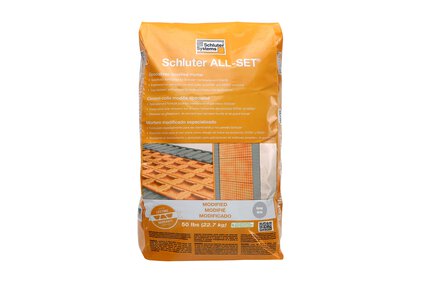
Schluter-Systems requires the use of Schluter SET™ , ALL-SET™ , FAST-SET™, or an unmodified thin-set mortar meeting the requirements of ANSI A118.1 to install...
Leer másHow do I receive a lifetime warranty?
Can I install alternate floor coverings over Schluter®-DITRA-HEAT or Schluter®-DITRA-HEAT-DUO instead of tile or stone?
The Schluter®-DITRA-HEAT system is suitable for applications with engineered wood, vinyl, wood plastic composite (WPC), luxury vinyl tiles (LVT), luxury vinyl planks (LVP) and more.
Leer másCan I install a tile format smaller than 2”x2” over an uncoupling membrane?
Applications with tile formats less than 2” x 2” (50 mm x 50 mm) require special considerations, please...
Leer más
Schluter®-DITRA-HEAT Evaluations and Listings
Schluter®-DITRA-HEAT-DUO is listed by cUPC
Evaluations and Listings - Heating Cables
Schluter®-DITRA-HEAT-E-HK Heating Cables are certified by CSA to CAN/CSA-C22.2 No. 130-16 (Canada)
Schluter®-DITRA-HEAT-E-HK Heating Cables are certified by CSA to UL 1673 (US)
Schluter®-DITRA-HEAT-E-HK Heating Cables are listed by UL to UL 1683 (US) and CAN/CSA-C22.2 No. 130-16 (Canada)

Ver y aprender
Acerca del producto
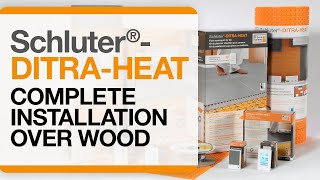
How to install DITRA-HEAT over Wood Start to Finish
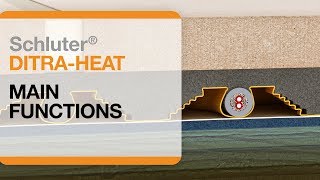
Schluter®-DITRA-HEAT: Main Functions

How to install DITRA-HEAT electric floor warming in a shower

Schluter®-Systems Warranties
Mike Holmes on Schluter®-DITRA-HEAT
Encuentre tutoriales y videos de documentación de proyectos para aprender cómo sacar mejor provecho de nuestros productos, ¡empiece ahora y diviértase!
Ver más vídeos / listas de reproducción