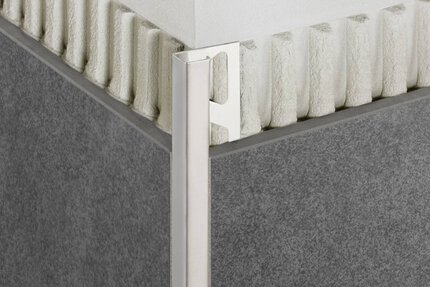
Schluter®-FINEC
Finishing and edge-protection profile with a minimalist design

- Prevents tile edges from chipping
- Ideal for creating decorative transitions on walls
- Ideal for use with mosaic tile
- Features a slim and elegant reveal
- Available in stainless steel, as well as various finishes of anodized aluminum



Find recommended accessories here

Profile Estimator
Discover what you need for tile protection and easy transitions.
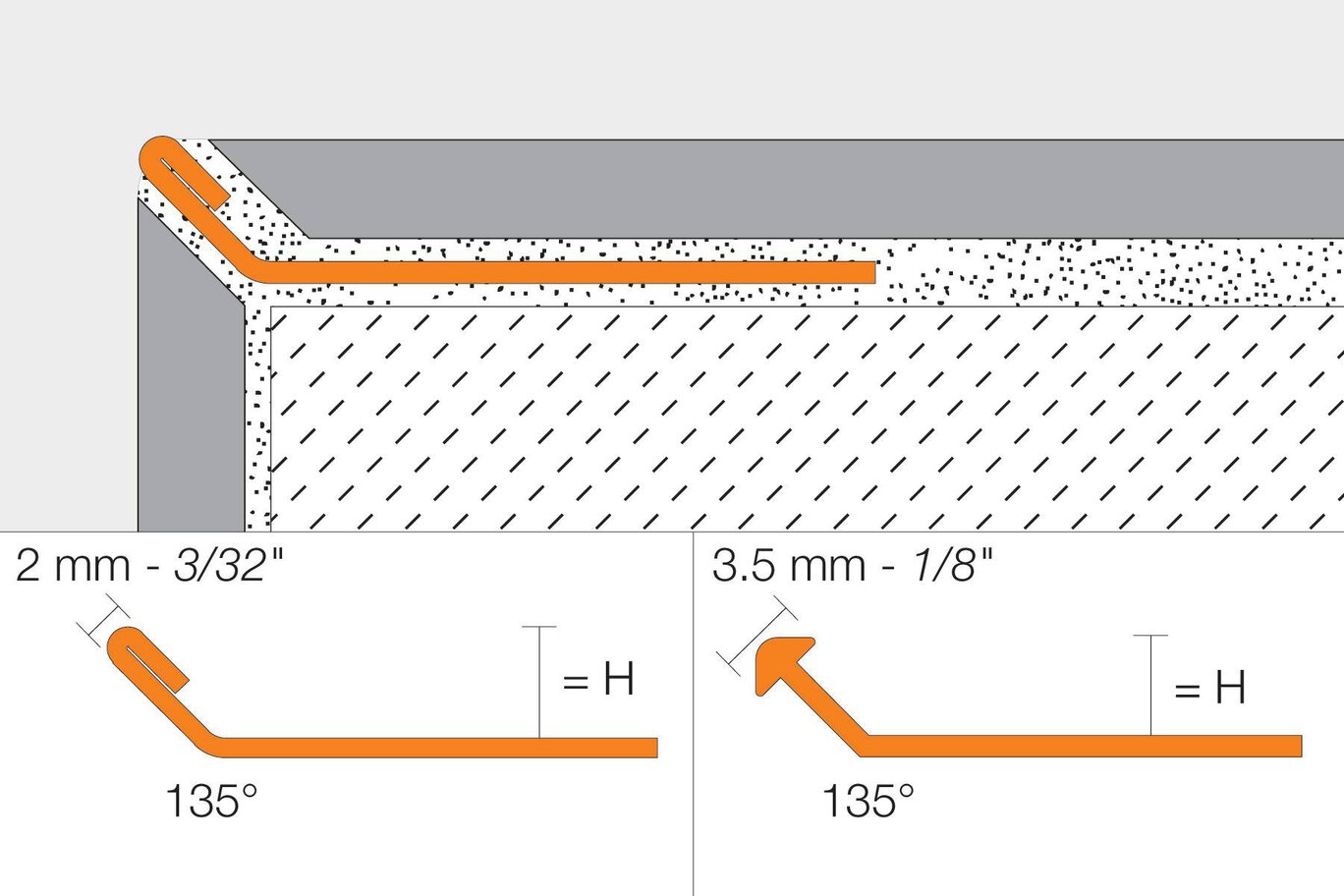
Schluter®-FINEC is a finishing and edge protection profile for the outside corners of tiled surfaces or mosaics.
The profile is available in stainless steel, anodized aluminum, and textured color-coated aluminum. FINEC, in stainless steel, is particularly resistant to wear when used as edge protection. It may also be used as a stair nosing profile.
Le profilé Schluter®-FINEC ne requiert aucun soin ou entretien particulier et est résistant aux moisissures et aux champignons. Nettoyez périodiquement les profilés au moyen d’un produit de nettoyage neutre.
Le profilé Schluter®-FINEC ne requiert aucun soin ou entretien particulier et est résistant aux moisissures et aux champignons. Nettoyez périodiquement les profilés au moyen d’un produit de nettoyage neutre. Les surfaces en acier exposées aux conditions ambiantes ou à des substances chimiques fortes doivent être nettoyées périodiquement avec un nettoyant neutre. Un entretien régulier favorisera la préservation de l’apparence de l’acier inoxydable et réduira les risques de corrosion. Évitez les acides puissants (ex. : acide chlorhydrique ou fluorhydrique) et les nettoyants alcalins (ex. : eau de javel, ammoniaque, chlore). N’utilisez pas de nettoyants ni d’outils abrasifs. Les surfaces d’acier inoxydable deviennent plus lustrées lorsqu’on les nettoie au moyen d’un produit de polissage pour chrome.
1. Select the profile according to tile thickness and format.
2. Using a notched trowel, apply thin-set mortar to the area where the profile is to be placed. If the FINEC profile is to be used as edging for an outside wall corner, finish tiling one wall first; then trowel thin-set mortar over the corner area of the second wall.
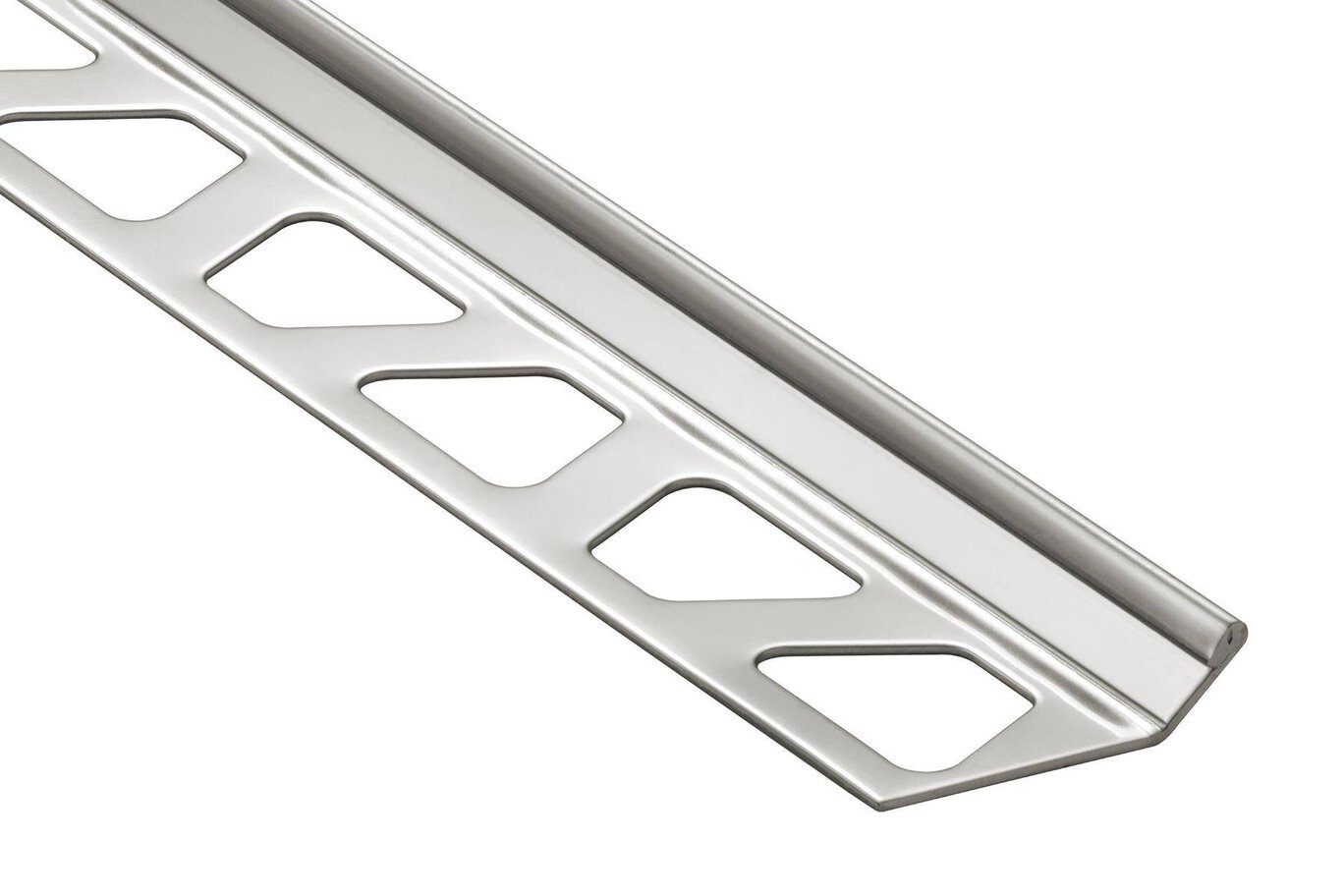
3. Press the perforated anchoring leg of the profile into the mortar and align.
4. Trowel additional thin-set mortar over the perforated anchoring leg to ensure full coverage and support of the tile edges.
5. Bevel tiles adjacent to the profile by 45°. Solidly embed the tiles so that the tiled surface is flush with the top of the profile; the profile should not be higher than the tiled surface, but rather up to approx. 1/32" (1 mm) lower.
5a. If the FINEC profiles, in aluminum, are used to create a 3 way external corner, into which the two upper profiles were fitted at an angle of 45°, cut the adjoining lower profile to size. The trapezoid-perforated anchor¬ing leg, including the joint spacer, must be cut off straight to the visible area by a minimum dimension x, depending on the profile length; see the AE illustration in the technical data sheet.
5b. If the FINEC profiles, in stainless steel, are used to create a 3 way external corner, into which the two upper profiles were fitted at an angle of 45°, cut the adjoining lower profile to size. In this case, the trapezoid-perforated anchoring leg must be cut off by a minimum dimension x, depending on the profile length, including the visible area has to be chamfered at a 45° angle; see the E illustration in the technical data sheet.
6. Set the tiles to the integrated joint spacer, which ensures a uniform joint of 1/16" to 1/8" (1.5 – 3 mm). With stainless steel, leave a space of approximately 1/16" - 1/8" (1.5 - 3 mm) between the profile and the tile.
7. Fill the joint completely with grout or setting material.
8. Work with materials and tools that will not scratch or damage sensitive surfaces. Setting materials must be removed immediately, especially from aluminum.
FAQ
How do I cut profiles?
Schluter™ profiles are available in a variety of different materials , so methods for cutting vary. Below are best practices for cutting according...
Read more