Commercial Shower Waterproofing: Why the Drain Matters
Two Trades. One Risk.

Ryan Dode runs commercial sales for Schluter Systems. A few months ago, he was in a room with 400 commercial construction professionals in New York — architects, general contractors, remodelers, tile contractors. He asked the room a simple question:
“How many of you know what a bonding flange is?”
Almost no hands went up.
These were experienced professionals. Not newcomers. People who have specified, built, and waterproofed commercial showers for years, including the mechanical engineers who specified the drains. And almost none of them could identify the component that sits at the center of every drain assembly they have ever specified or installed.
Tile is not waterproof. The drain is where that matters most.
It is one of the most persistent misconceptions in commercial construction: that a tiled surface is a waterproof surface. It is not.
Tile, grout, and stone are water-resistant at best. Moisture migrates through grout joints, works through setting beds, and accumulates at the substrate in both liquid and vapor form. In a commercial shower, locker room, or wet room, that moisture must go somewhere. If the assembly is not designed to manage it at surface level, that moisture goes somewhere else: into the air, into the substrate, or through the floor into the space below.
The result is predictable: mold, mortar bed deterioration, tile delamination, structural damage. In commercial environments, the remediation bill is significant. In hospitality, healthcare, or multi-unit residential, add lost revenue and scheduling disruption.
Two systems. One connection point.
A commercial shower is not one system. It is two systems that have to work together.
The plumbing system manages water flow and drainage. The waterproofing system protects the building structure. These systems are designed by different disciplines. Plumbing is specified under Division 22 and tile is specified under Division 09. They are installed by different tradesmen and women who may never be in the same room at the same time.
The drain is the only place those two systems are required to function as one.
In traditional drain assemblies, that connection depends on field coordination and materials built up in stages. A mortar bed, a pan liner, a clamping ring, with tile set on top. When every step is executed in the right sequence, the assembly performs. When it is not, the connection at the drain is where the failure begins.
Most mechanical engineers who specify commercial drains were trained on those traditional methods. The drain was a plumbing specification. The waterproofing was a tile specification. The two documents lived in different divisions and the responsibility gap between them lived at the drain.
The two-stage drain method worked. Contractors knew it, inspectors passed it, buildings stood. Nobody was doing it wrong. But it was built around a constraint: plumbing and waterproofing had no common interface. The pan liner bridged that gap as best it could. It asked two trades to coordinate a connection that neither one fully owned. The industry needed a different way to think about the connection between trades. It already existed.
The rotary phone worked too. It connected calls. People built entire communication systems around it. And then a different approach came along that solved the underlying problem rather than working around it, and the people who made the switch did not go back. The smartphone did not just make calls better. It redefined what a phone could do. The bonding flange is not a better version of the two-stage drain. It is a different answer to the same problem. One that defines the connection between trades rather than leaving it to be resolved in the field.
The connection point that changed the standard.
Werner Schluter did not set out to reinvent the drain. He set out to solve a defined problem: tile and plumbing are two separate trades, and where they meet has always been where installations fail. His answer was the bonding flange. That drain became KERDI-DRAIN.
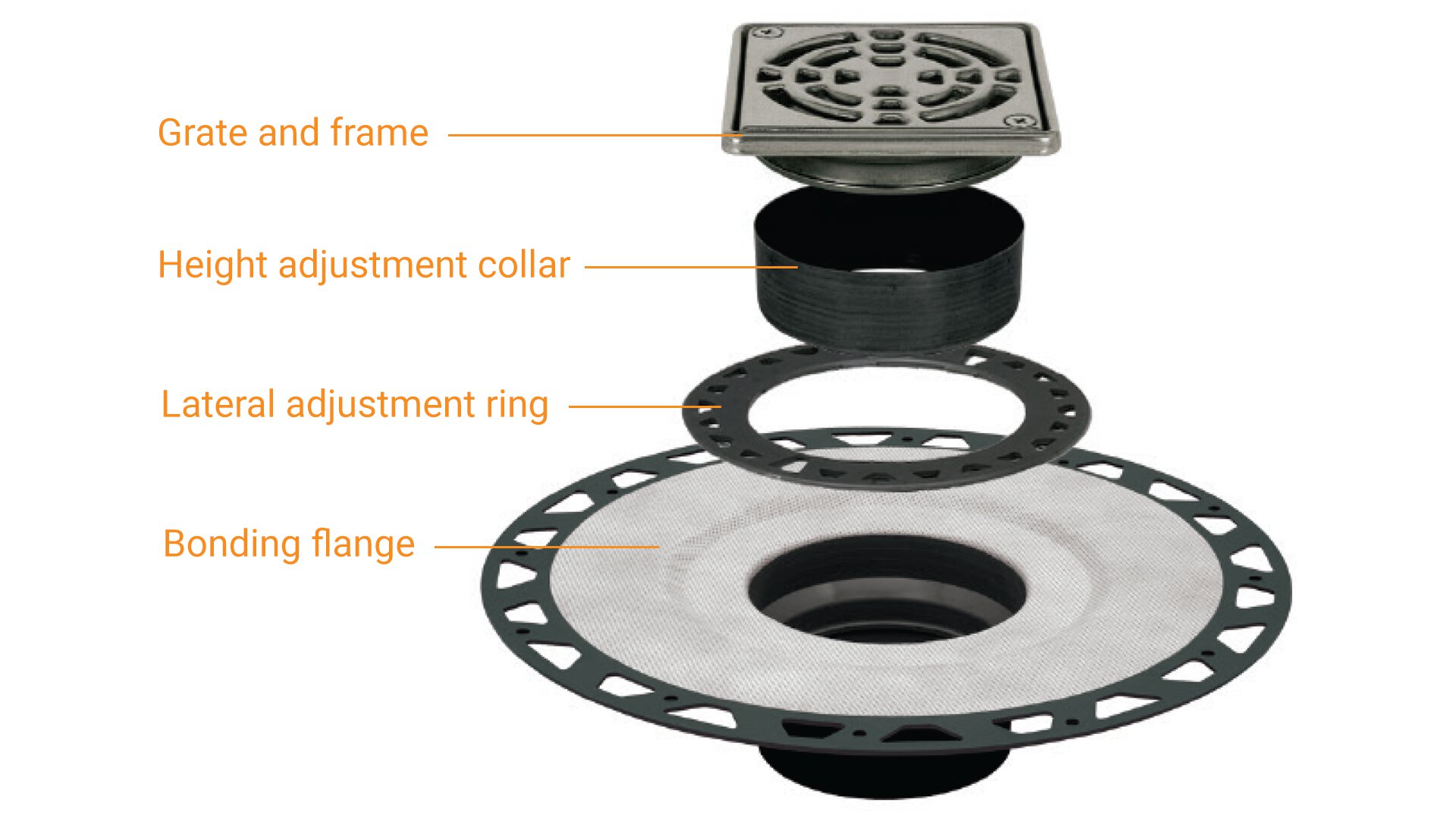
Rather than building the waterproofing connection in stages, the bonding flange defines it from the start. A wide, flat flange is integrated directly into the drain body. The waterproofing membrane bonds directly to that flange, creating a continuous topical seal at the drain opening. The connection is surface-level, verifiable, and complete before a single tile is set.
You can’t see it. That’s the point.
When a bonded waterproof membrane assembly is installed correctly, there is nothing to see. The tile is flat, the grout lines are tight, the drain sits flush. The system is working exactly as designed, completely out of view. The bonding flange is the reason it stays that way.
What this means for commercial projects.
When a drain is specified without considering how it integrates with the waterproofing assembly, that connection gets resolved in the field. In commercial construction, field-resolved connections are where risk concentrates and where liability originates.
Specifying the drain and the waterproofing assembly together shifts that connection from a coordination problem to a defined specification. The risk profile changes. The handoff between trades is no longer an assumption. It is a designed interface.
For mechanical engineers: the mechanical engineer is the primary drain specifier on commercial projects. Not the architect, not the tile contractor. If the drain spec still reads like a plumbing-only decision, the waterproofing integration is being left to chance. Tile Council of North America's Handbook Method B422 addresses that directly. It is the current standard, it is specifiable today, and it is how the two-trade dependency gets resolved at the design stage rather than in the field.
For general contractors: the bonding flange eliminates the dependency between the plumbing and tile trades at the most vulnerable point in the assembly.
For tile contractors: The drain was never yours to specify in a commercial project. But the bonding flange completes your waterproofing system. Know what it is. Know why it matters. When the drain is right, your work holds.
Most of the commercial industry has not made the switch yet. Not because the old method is better. Because that is what they have always used.
The bonding flange is already the standard. Most of the industry just has not upgraded yet. And when the assembly is done right, nobody will ever know it is there.
Explore the Schluter drain portfolio: